 Gamma
Gamma
Gamma limit orders use pool tick spacing to set price boundaries
Gamma limit orders use pool tick spacing to translate target prices into narrow liquidity ranges. An entered price may round to a permitted tick, and the order must sit on the correct side of the pool’s current price. Conversion occurs as swaps move through that range, so its boundaries, the chosen token, and the execution state all affect what the order means.
Price precision starts with the selected pool and quote direction. A single-price order concentrates conversion in one permitted interval. Scale orders spread it across several intervals, adding constraints on order count and token allocation.
Pool liquidity and the swap hook work together
The order manager supplies one token as liquidity in a narrow pool range, while the swap hook handles execution after qualifying price movement. Swappers trade against that liquidity as the pool price enters the interval. The position gradually exchanges its starting token for the other currency. Once the price passes the relevant outer boundary, the hook can remove the converted position. Price movements in other pools don’t trigger this position’s execution hook.
A liquidity provider (LP) vault manages capital across its strategy’s positions over time. A limit order uses a defined range for a particular token conversion. Both involve concentrated liquidity, but their practical settings differ: the order’s boundaries express where conversion should occur. Its existence doesn’t imply that market activity will reach those boundaries.
Single-price and scale orders allocate tokens differently
A single-price order assigns tokens to one narrow interval, whereas a scale order distributes a total allocation across several intervals within selected bounds.
One target interval
The single-order call takes a target tick and the token amount. The manager derives the lower and upper boundaries from that tick, the pool’s spacing, and the input currency. Even this concentrated order occupies an interval. The target identifies a boundary of that interval; it doesn’t turn the whole position into liquidity at a mathematical point.
Several target intervals
Scale orders add a requested count and a size distribution. Changing the distribution changes how much capital each interval receives. Changing the count changes how many individual intervals the manager creates. More intervals require enough room between the bounds, and each constituent order remains subject to the applicable funding constraints.
Tick spacing sets the usable boundary grid
The pool’s spacing limits which ticks can serve as liquidity boundaries; its spot price can still move between those boundaries as swaps consume available liquidity. A tick is an index on a multiplicative price scale. At tick t, Uniswap v4’s raw token1-to-token0 price ratio follows 1.0001 t . The raw ratio uses the currencies’ smallest units. Token decimals determine how that ratio translates into the price shown per whole token.
Let s denote the pool’s tick spacing. Usable position boundaries lie at integer multiples of s. Moving between adjacent usable boundaries multiplies the raw price by 1.0001 s . Larger spacing therefore means coarser choices in proportional price terms. It doesn’t establish a fixed gap measured in a fiat currency, and it doesn’t describe every price at which swaps can trade inside the interval.
Token ordering and decimals give a tick its meaning
The same tick index needs the pool’s currency order and token decimals before it can express a meaningful target price in the units that a reader expects.
The quote direction
Uniswap v4 orders its pool currencies by address and expresses the raw ratio in token1 units per token0 unit, so interpreting a buy or sell label requires both the supplied token and the quote direction. A display that uses the opposite quote shows the reciprocal price, so increasing tick indices correspond to decreasing prices in that inverted view.
The token units
Each currency’s decimal scale converts raw units into whole tokens. For the token1-per-token0 quote, multiply the raw ratio by 10 d0-d1 , where d0 and d1 are the respective decimal counts. Ignoring that adjustment can produce a price with the wrong magnitude. Extra decimal places in a display don’t create extra usable ticks or change the pool’s permitted boundaries.
Why can’t I place an order at my exact target price?
The target may fall between spacing multiples, or its rounded interval may lie too close to the current pool price for the selected input token. Gamma’s tick logic rounds token0 targets downward and token1 targets upward to the permitted grid. It also rounds the current tick for the selected direction. A target that passes an initial above-or-below comparison can therefore fail the subsequent spacing check. The accepted lower and upper ticks describe the position that the manager will create.
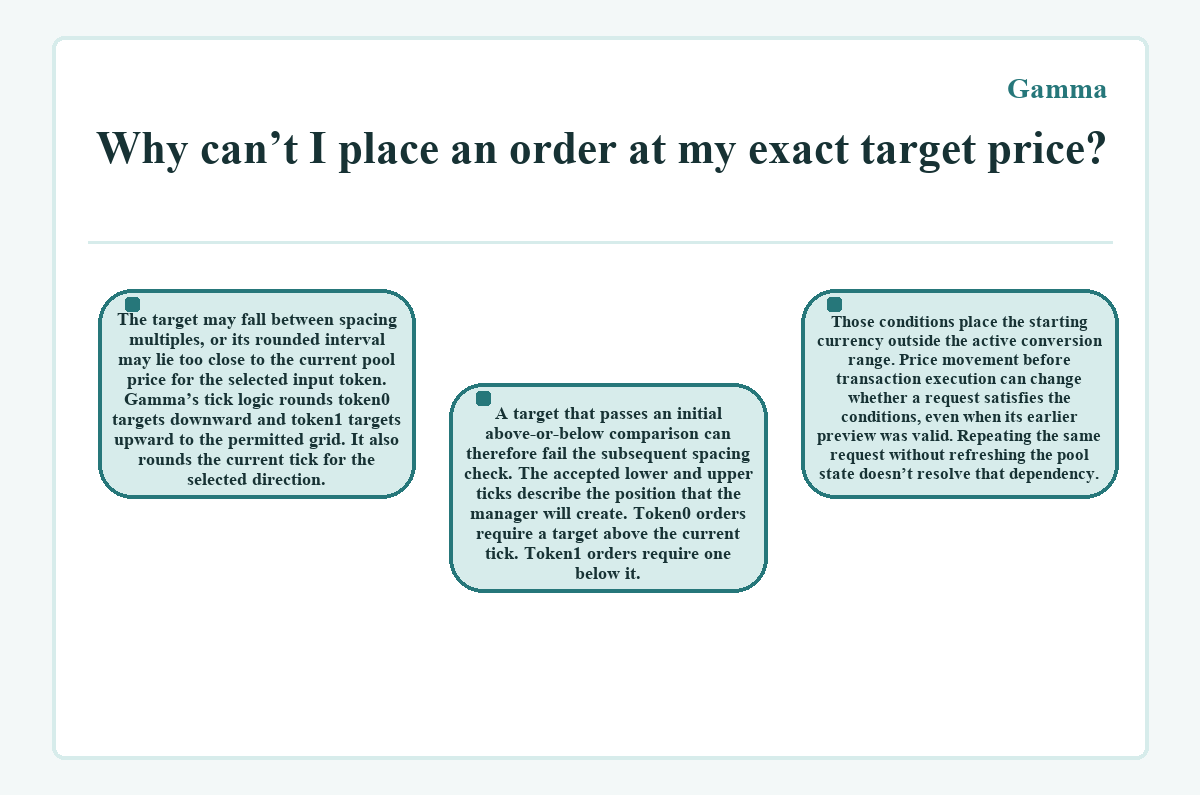
Token0 orders require a target above the current tick. Token1 orders require one below it. Those conditions place the starting currency outside the active conversion range. Price movement before transaction execution can change whether a request satisfies the conditions, even when its earlier preview was valid. Repeating the same request without refreshing the pool state doesn’t resolve that dependency.
Range width limits the number of scale orders
The width remaining after boundary rounding limits how many separate scale orders can fit inside the chosen range. A narrower interval can invalidate a requested count.
Space for separate positions
Gamma’s scale-order tick validation requires at least two constituent orders. Once the endpoints align to spacing s, the number of available spacing intervals equals the upper tick minus the lower tick, divided by s. The requested count can’t exceed that capacity. Rounding the endpoints inward may reduce the available room or collapse the range entirely.
The manager’s count setting
The manager also applies its configurable
maxOrderLimit
to a scale-order request. A range with enough tick intervals can still exceed that setting. Gamma’s Python software development kit (SDK) exposes a count-range query for selected price bounds; the creation transaction still evaluates its actual parameters and pool state.
Pool eligibility and funding constrain order acceptance
The Uniswap v4 order manager requires an enabled pool, the matching hook, and a funded input amount before it can accept a price-aligned order. Its creation path also requires an unpaused manager. Adding an order to a position awaiting keeper execution reverts. A nonzero amount must satisfy the configured minimum for the supplied currency. ERC-20 inputs need sufficient allowance for the manager’s token transfer. Scale-order allocation matters here because dividing a total amount changes individual order sizes. Increasing the deposit can address an amount constraint, while the pool’s spacing continues to govern price boundaries. The manager’s currency minimums and order-count limit can change through configuration.
Pool swaps determine the execution opportunity
A qualifying swap in the selected pool gives the hook its execution opportunity, even if another market has already traded through a visually similar target price. The hook records the tick before the swap and reads it again afterward. It passes that movement and its direction to the order manager. Token0 conversion completes toward the upper boundary; token1 conversion completes toward the lower boundary. Merely entering the position’s range can leave both currencies in the liquidity position. Removing a fully converted position ends its exposure to later swaps through that range. Some eligible positions can require keeper follow-up when the swap crosses more eligible positions than the configured execution limit permits.
A rounded target can pass placement and still await conversion
In this hypothetical case, a token0 order requests target tick 1317 while the pool’s current tick is 1237 and its spacing is 17 ticks. Assume the pool is enabled, the hook matches, creation isn’t paused, the position for this pool, range, and input token isn’t awaiting keeper execution, and the supplied amount and allowance satisfy the manager’s requirements. These inputs describe an illustrative pool state, not live settings.
The target rounds down to 1309, which equals 77 multiplied by 17. The direction-specific current-tick calculation gives 1241. Their difference is 68 ticks, so the request passes the spacing check. The manager creates boundaries at 1292 and 1309. Its creation record establishes that interval and the order’s identity; it doesn’t establish completed conversion.
If a later swap crosses the upper boundary and the manager executes this position, its execution event and inactive state establish removal. A subsequent claim attempts to transfer the resulting entitlement to the owner. The claim’s actual incoming token transfer to the receiving wallet establishes receipt. Neither the entered target nor the earlier creation transaction proves that the wallet already holds those proceeds.
If the current tick instead reaches 1297 before placement executes, its rounded value becomes 1309. The unchanged target also rounds to 1309, producing no spacing gap. The request fails with
RoundedTicksTooClose
and creates no order. Another submission needs an updated calculation of the permitted bounds. Waiting for conversion or attempting a claim can’t complete that rejected request.
Keeper follow-up depends on the later pool price
The configurable execution limit bounds how many eligible positions the manager processes during a swap. It marks excess positions for an authorized keeper, so a boundary crossing can precede removal.
Keeper execution rechecks the current tick. Token0 positions need a tick at or above their upper boundary; token1 positions need one below their lower boundary, and either position must still retain liquidity and carry the waiting flag. If those conditions no longer hold, the keeper call clears that flag instead of forcing execution at an unsuitable state.
A position that remains in the pool can exchange back toward its starting currency if swaps reverse through its range. Clearing the waiting flag doesn’t itself cancel the liquidity or transfer tokens to its owner. The later pool state therefore affects delayed execution, and a past crossing alone doesn’t preserve a completed conversion while the position remains open.
Range prices and claim amounts describe different results
A target boundary identifies one edge of the conversion interval, while the withdrawn principal reflects the tokens that the position actually converts across that interval. The amount also follows the liquidity calculation and integer rounding.
The claim calculation deducts the hook fee from accrued liquidity fees. Principal and earned fees occupy separate accounting fields. Fees can involve both pool currencies, so their token units remain relevant to the final transfer.
Network gas adds another cost to submitted transactions. A narrow range can improve control over where conversion occurs, without fixing the net economic value after those transaction costs.
The claim callback includes a fallback that redirects an unsuccessful user payout to the treasury. A successful claim transaction therefore doesn’t always establish receipt by the intended wallet. Its
FailedTransferSentToTreasury
event identifies that fallback path.
Gamma - your questions answered
-
Does a dynamic pool fee change the spacing between limit order prices?
- Changing a Uniswap v4 pool’s dynamic liquidity fee doesn’t change that pool’s tick spacing. The pool key keeps the fee configuration and spacing as separate fields. A fee update can affect trading economics while leaving the usable boundary grid unchanged. Another pool with the same currencies can use a different spacing.
-
Can a Gamma limit order use a negative target tick?
- A negative target tick can represent a valid positive price. Tick indices measure a multiplicative token ratio, so negative indices correspond to ratios below one in raw token units. The order still needs spacing-aligned boundaries within the permitted tick range and a target on the correct side of the current tick.
-
Is a stop-loss order equivalent to this single-sided limit order?
- A conventional sell stop-loss can’t be reproduced just by moving this single-sided order’s target below the market. A range order needs the selling currency on the permitted side of the current price. A stop-loss sale after a falling price requires separate conditional execution support; tick rounding alone doesn’t supply that capability.
-
Does inverting the displayed quote change an existing limit order?
- Displaying the reciprocal quote leaves the existing order’s on-chain position unchanged. The display changes the price units and reverses which numerical direction looks higher or lower. The order retains its pool, supplied currency, and actual tick boundaries. Any new order request must interpret its side and target in the chosen quote direction.
-
Do I need an LP vault deposit before placing a Gamma limit order?
- The Uniswap v4 limit-order manager doesn’t require an LP vault deposit to create an order. Its order-creation call takes the supplied currency, target tick, amount, and pool key. The applicable requirements concern that order’s pool eligibility, token funding, and price range. An existing vault position doesn’t satisfy those requirements automatically.