 Gamma
Gamma
Gamma vaults for concentrated liquidity change their asset mix as pool prices move
Gamma vaults for concentrated liquidity return a share of their current assets, so pool price changes can alter the tokens you receive on withdrawal. Swaps exchange the assets inside each active price range. Automated range management changes where that liquidity participates. Your vault shares track participation in the managed inventory; they don’t reserve the quantities that you originally deposited.
The question at withdrawal is which assets your shares represent at that moment. Token quantities, market values, and range settings describe different parts of the answer. Gamma’s liquidity-provider (LP) vaults are separate from its limit orders and perpetual trading vaults.
Active price ranges determine the changing token balances
A concentrated-liquidity position assigns assets to an interval between lower and upper pool prices. Swaps within that interval exchange one token for the other, so their amounts move with the pool price even when nobody adds or removes liquidity.
The direction becomes clearer when the quote stays consistent. If the pool quotes the first token in units of the second, a rising price reduces the first-token amount. The position accumulates the second token as traders buy the first. Falling prices move those balances the other way while the position remains active. Reversing the displayed quote also reverses what rising means.
At either boundary, that position’s principal reaches a single-token balance. Beyond its range, it stops supplying active liquidity and earning new swap fees. Existing fees remain part of its accounting. A later return into the same interval can reactivate the position.
A vault can combine positions with different boundaries and also hold undeployed assets. One inactive position therefore doesn’t establish that the whole vault holds one token or earns no fees.
Holding tokens and managing liquidity give different control
Holding the pair in a wallet preserves its quantities unless another action changes them. Providing liquidity lets pool trades change those quantities in exchange for fee income. Gamma adds automated management over the ranges, so the choice includes who adjusts the exposure.
| How the pair is held | Control over token allocation |
|---|---|
| Paired tokens in a wallet | The holder controls transfers and swaps; pool trades don’t change these wallet balances. |
| Directly managed concentrated liquidity | The holder selects the range; pool swaps determine the position’s token mix within it. |
| Gamma LP vault shares | The strategy manages ranges; the share holder redeems a claim on the vault’s managed assets. |
| Delegating range management changes who sets liquidity exposure; redemption still follows the assets backing the position. | |
A vault deposit moves the underlying tokens into smart contracts. Holding its shares preserves a redemption claim, with exposure to the vault and pool contracts.
What determines the tokens I receive when I withdraw?
The vault’s accounted holdings when redemption executes determine the paired assets that your shares can return. For a classic Hypervisor vault, that inventory includes the base position, the limit position, and unused token balances. Withdrawal draws from these components in proportion to the shares that you redeem. A pool-wide token ratio isn’t necessarily the ratio of this particular vault.
A Hypervisor withdrawal burns the redeemed shares in exchange for their proportional underlying assets. The share fraction is the redeemed shares divided by total share supply. The contract accounts for accrued fees and applies its fee rules. Integer rounding also affects the final token amounts.
Redeeming part of a position reduces the number of shares that you hold. The remaining shares continue representing managed liquidity.
A Hypervisor withdrawal specifies the recipient of the redeemed tokens, which can differ from the share holder. The transaction’s target contract and the recipient of its asset transfers have different roles.
Quantity changes and value changes answer different questions
Token quantities describe what redemption returns; valuation describes what those tokens are worth in a common unit. A value-weighted allocation can change when market prices change, even without a matching change in token counts. Comparing raw quantities across different assets doesn’t establish equal exposure. Token contracts can also use different decimal precision. A displayed balance needs the correct unit conversion before it can support a value comparison. The pool’s exchange price and each token’s broader market value describe different relationships.
Fees add inventory while prices alter exposure
Trading fees contribute additional token balances to the LP position. Gamma’s strategy can reinvest accrued fees into managed liquidity, so the assets behind each share needn’t equal principal alone. Reinvestment changes the amount of capital participating in later trades. It doesn’t fix the share holder’s balance to the original pair quantities. Protocol charges on earned fees also affect the assets that remain attributable to LPs.
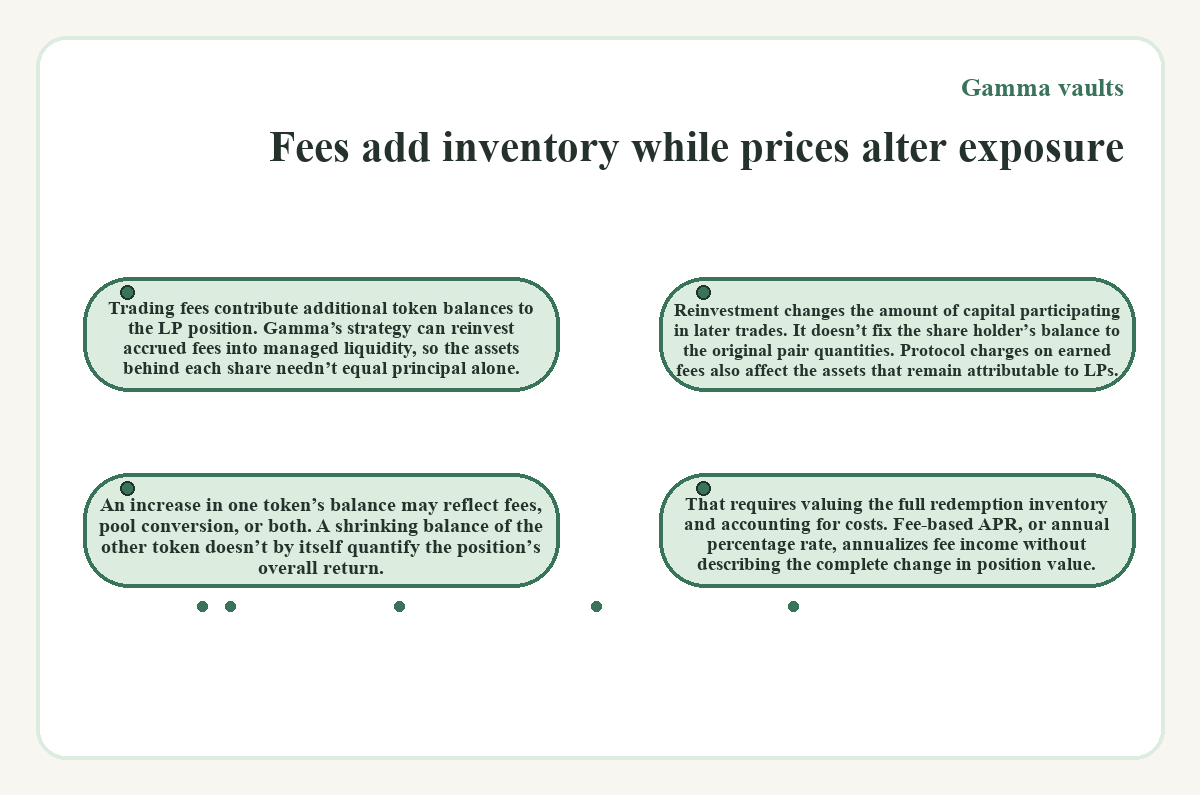
An increase in one token’s balance may reflect fees, pool conversion, or both. A shrinking balance of the other token doesn’t by itself quantify the position’s overall return. That requires valuing the full redemption inventory and accounting for costs. Fee-based APR, or annual percentage rate, annualizes fee income without describing the complete change in position value.
Range management changes where inventory responds
Gamma’s LP strategies respond to price or asset-allocation triggers. Their management logic runs offchain, with the resulting changes executing onchain. Gamma’s LP rebalancing uses limit liquidity positions without executing market swaps. Those positions seek the desired token balance through liquidity provision. Conversion still requires trading against that liquidity; resetting a range doesn’t recreate the original inventory.
Range width affects how much price movement a position spans before reaching a single-token boundary. Narrower ranges concentrate exposure and can generate stronger fee income while prices remain nearby. Sharp or sustained moves can also produce greater divergence costs. Wider ranges extend coverage while spreading capital across a broader interval. Neither width establishes a fixed withdrawal ratio or a fixed time between rebalances.
Multi-position vaults distribute capital across several ranges, so different parts of their inventory can become active at different prices. Gamma’s Uniswap v4 strategies include distributions that cluster liquidity near the price and distributions that spread it more evenly. The Uniform shape spreads liquidity evenly, while the Gaussian shape clusters it around the price. The combined token mix follows those allocations as well as price movement.
The starting portfolio remains the performance benchmark
Impermanent loss measures the value lost relative to holding the original tokens when their relative price changes. The comparison needs the same starting assets and deposit time, valuing both portfolios at the same later prices. A position can rise in market value and still lag the assets that it would have held. Fee income may offset that difference, though its contribution varies with trading activity.
Returning to an earlier pool price doesn’t guarantee that an actively managed vault will return the starting quantities. Range changes and accumulated fees can alter the position along the way. A price chart alone therefore can’t establish recovery of the original token mix.
Can the withdrawal preview change before the transaction confirms?
A withdrawal preview can change before execution because pool trades and vault management can change the underlying inventory. It estimates the assets behind a selected share amount at the state used for that preview. Signing a transaction doesn’t reserve that state. Later execution follows the contract’s applicable rules and the holdings available then. Hypervisor v1.3 checks minimum token amounts for each nonzero base or limit liquidity burn. A failed check reverts the withdrawal. These bounds cover those burns, while redemption also includes proportional idle balances.
The transaction’s success and resulting token transfers establish the actual withdrawal. A pending hash doesn’t establish the quantities received. Classic Hypervisor vaults record the share holder, recipient, burned shares, and returned token amounts when redemption succeeds. Those quantities appear in the Hypervisor
Withdraw
event.
Gamma vaults: the short answers
Does staking Gamma LP shares freeze their token composition?
Staking Gamma LP shares doesn’t freeze the liquidity that backs them. In an incentive program that stakes Gamma LP shares, the rewards contract holds those shares while the underlying vault position continues. Pool trading and range management can therefore change the eventual redemption mix. Incentive tokens form a separate reward balance; their presence doesn’t show how much of either pool asset your shares represent.
Can I select just one token in a standard Hypervisor withdrawal?
A standard Hypervisor withdrawal returns the tokens attributable to the shares that you redeem. You can’t select a different asset mix within that redemption. Receiving a single chosen asset would require conversion if the redemption contains both tokens. Any such conversion has its own execution price and applicable costs, which differ from withdrawing the underlying pair.
Which factors let Gamma vaults for the same pair return different token proportions?
Vaults for the same pair can return different proportions when their positions or inventories differ. Range boundaries determine where each position converts assets, while capital distribution determines how much participates there. Undeployed balances and accrued fees also contribute to the total. Sharing token names doesn’t establish a shared redemption ratio, even when both vaults reference the same pool.
Will a price change on another exchange immediately change my vault’s token amounts?
A price change elsewhere doesn’t itself exchange the tokens inside the vault’s liquidity positions. Swaps in the relevant pool change their balances as its price moves. Strategies that have an established external reference price can also monitor departures from that reference. An external quote and the vault’s own inventory can therefore change at different moments.
Does a Gamma stablecoin vault preserve an equal asset split during a depeg?
A stablecoin vault can develop a strongly uneven asset allocation during a depeg. Its liquidity follows the pool’s relative price and the strategy’s range settings, even when both tokens normally target similar values. Trading can increase exposure to the token whose relative price falls. An automated strategy doesn’t establish an equal split or restore either token’s target value.